Meda of Odessos
MEDA OF ODESSOS was a Thracian princess of the Getae, daughter of king Cothelas, and one of the many wives of Philip II of Macedon, so, she was a barbarian stepmother of Alexander the Great. The Getae were a northern Thracian tribe related with the Dacians, who lived around the Danube River in what is now northern Bulgaria and southern Romania. During the reign of Philip II and his son Alexander, the Getae, like the rest of Thrace, became vassals of Macedon. Alexander fought the Getae during his Balkan campaign, at the beginning of his reign.
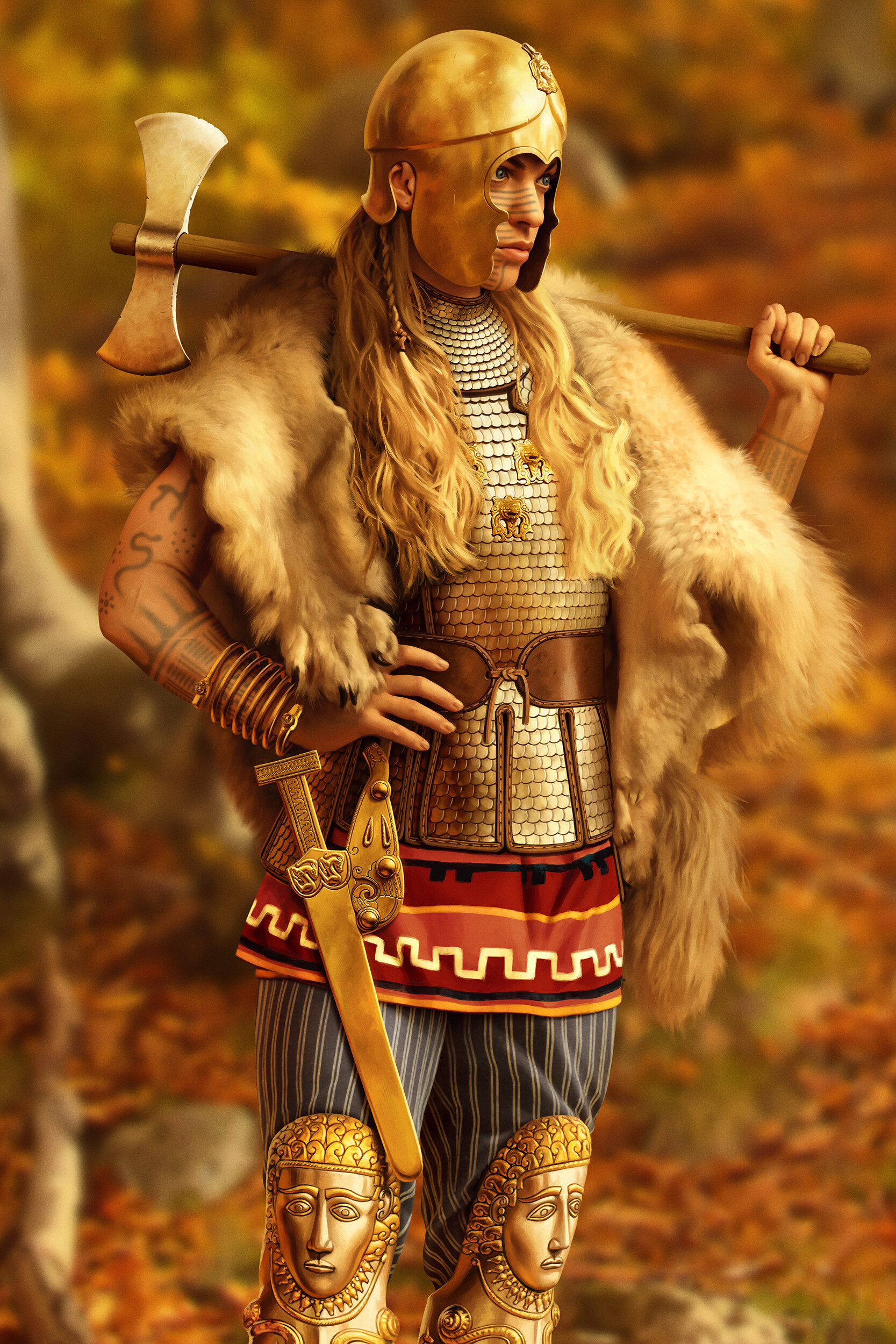
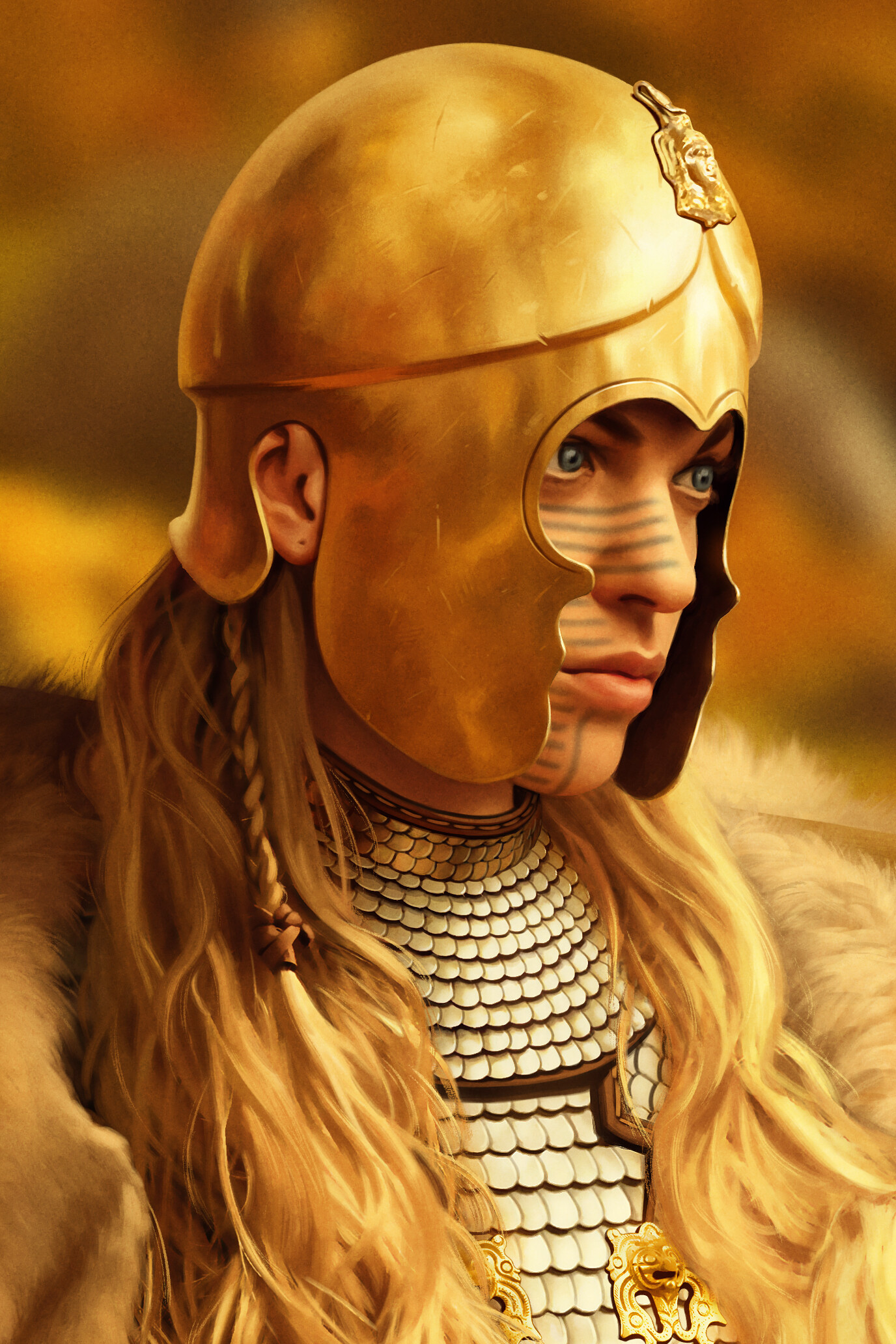
She wears a scale armour with a skirt of “pteruges” (shorter in the front and longer in the sides to facilitate riding a horse), a scale “gorget” and decorative appliques based on a real armour found at the Golyamata Mogila tumulus, an Odrysian tomb from Bulgaria. The gilded helmet is based on a find from the tomb of the Odrysian king Seuthes III. The greaves are based on several finds from northern Thrace, and in other greaves like these we can see female faces with horizontal lines that have been interpreted as tattoos, which have been used here as reference for the face tattoos of Meda. The tattoos on the arms are based on those worn by Thracian women in Greek vase paintings. Thracian tattoos are also mentioned by the Greek historian Herodotus as a sign of status. Thracian women painted on Greek vases are represented wielding comically large double axes known as labrys. Fancy double axes made of very thin bronze or gold were used as ceremonial objects in Minoan Crete, but in Thrace, there are countless finds of much simpler and thicker double axes made of iron, dating to the Classical and early Hellenistic periods. I also gave her a Thracian “akinakes” dagger, like those used by the nomadic Scythians and the Persians. While the southern Thracians living closer to Greece didn’t wear pants, the northern ones like the Odrysians and the Getae, more influenced by the Scythians, did wear them.