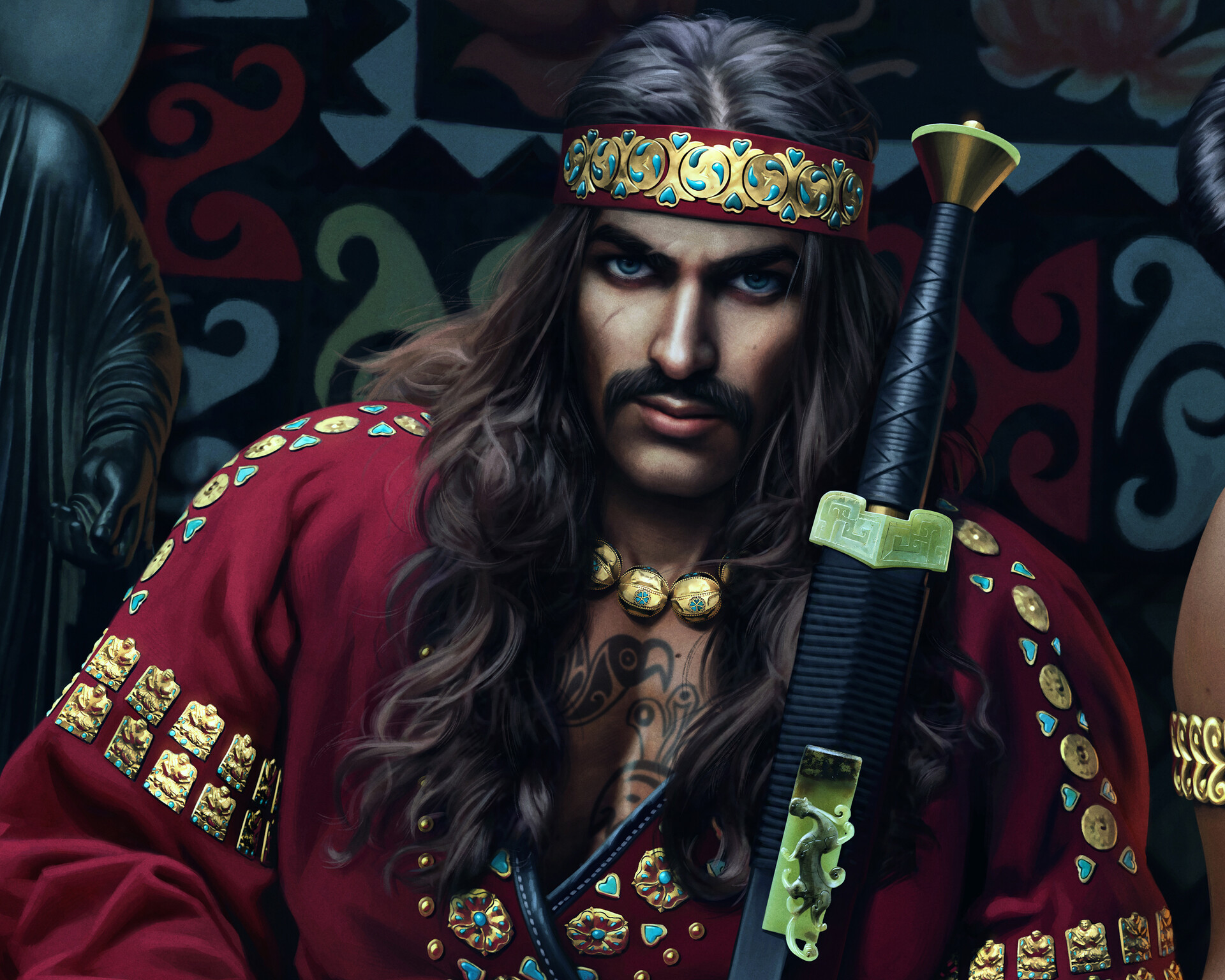
Indo-Scythian king
Indo-Saka or Indo-Scythian king (1st century). The Indo-Scythians were steppe nomads that invaded the Indo-Greek kingdom (one of the successor states of Alexander the Great) and stablished their own in north-western India. Just like the Indo-Greeks, the Indo-Scythians eventually adopted Buddhism, and continued the Hellenistic art school of Gandhara, the art school that produced the first anthropomorphic statues of Buddha in history. Not much is known about the Indo-Scythians, but they left behind several stuppas, as well as a burial site in modern Afghanistan known as Tillya Tepe, where aristocratic nomads were buried covered in gold. They were finally absorved by the Kushan Empire, also founded by steppe nomads known as the Yuezhi. This image represents an Indo-Scythian king based both on the finds of Tillya Tepe and Indo-Scythian, Parthian and Kushan coins that show a similar fashion, and by his side there's an Indian courtesan based on the ivories of Begram (Afghanistan, 1st century). The tapestries on the walls of the tent are based on textiles from Sampul (Tarim Basin, today's Xinjiang, China), showing the mix of Scythian and Hellenistic influences. The king holds a Chinese jian sword roughly based on the finds from the Orlat cemetery (Uzbekistan), and a Roman silver cup and a Chinese lacquer bowl have also found their way to this king's table trough the Silk Road.