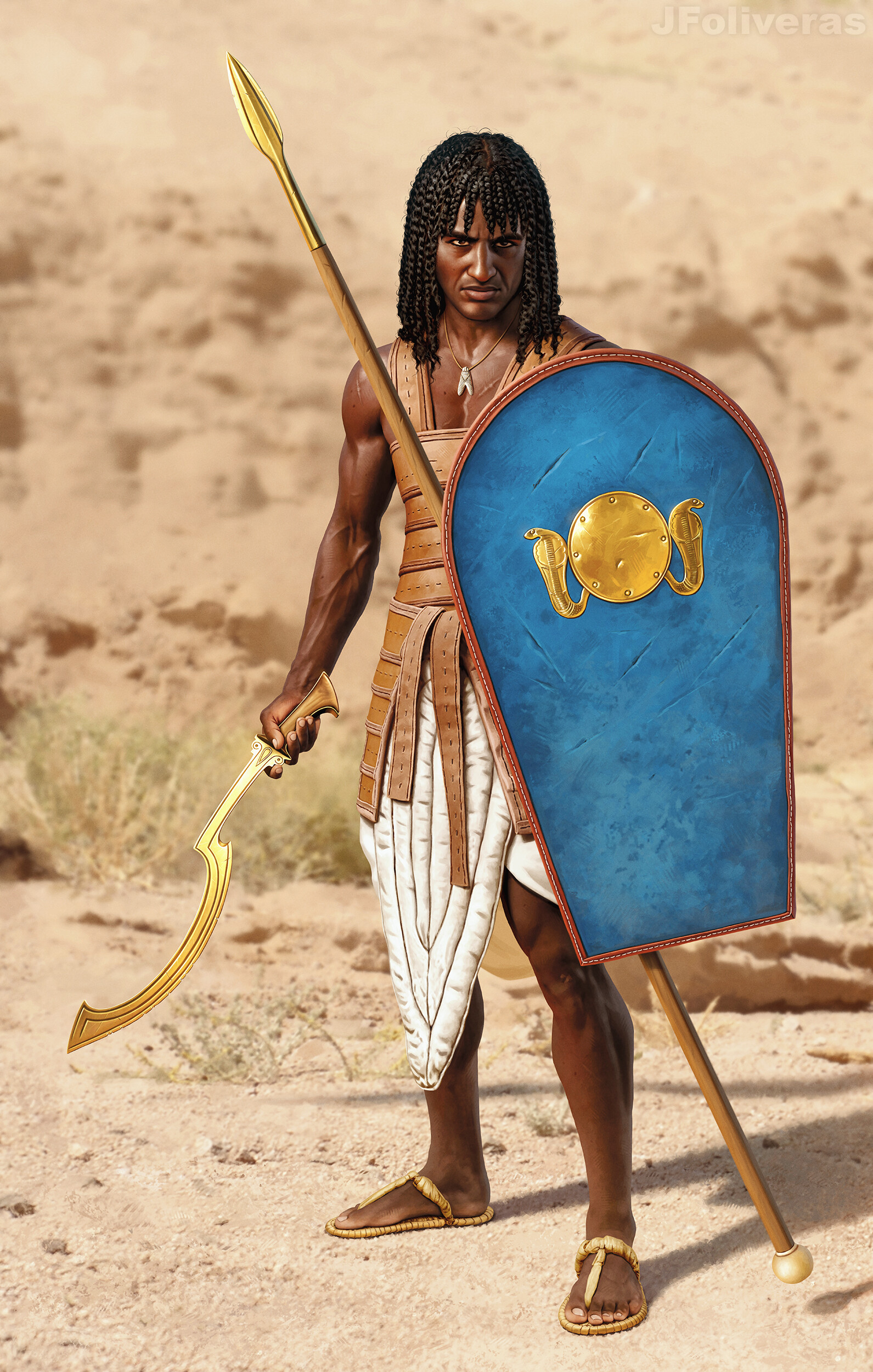
Egyptian soldier
EGYPTIAN SOLDIER of the New Kingdom (16th century BC – 11th century BC). More specifically, from the time of the Late Bronze Age Collapse. This could be one of the soldiers of pharaoh Ramesses III (1186–1155 BC) that fought against the invasion of the Sea Peoples (see my posts of Ramesses III and the Sherden warriors for more information about that). This soldier has been reconstructed based on reliefs of the temple of Ramesses III at Medinet Habu, and other temple reliefs from around the same period. In the reliefs of Medinet Habu, the soldiers of the pharaoh who crushed the Sea Peoples in two great battles are equipped with bell-shaped shields with a central boss, and the iconic sickle-shaped sword called “khopesh”, evidencing its use in warfare until the very end of the Bronze Age, contrary to what many people claim on the internet. You may have also noticed that unlike most reconstructions of New Kingdom Egyptian soldiers on the internet, mine doesn’t wear any headdress, which seems to be the case in most of the iconography I’ve seen, which depicts soldiers only with the typical braided hairstyles of Egypt. Probably copying the illustrations that the great Angus McBride did back in the day for Osprey Publishing, most modern artistic reconstructions depict Egyptian soldiers wearing a textile headdress known as “khat”, which was a simpler version of the more elaborate “nemes” worn only by the pharaoh. The problem is that the “khat” was only worn by members of the nobility. It seems that representations of some obscure type of padded helmet worn by some soldiers may have been mistaken as the “khat” back in the day, and it has ended up becoming a stereotype. For the khopesh and the spear, I’ve used replicas of archaeological finds made by Ørjan Engedal (The Bronze Age Warrior Series), and for the leather armour, a reconstruction made by The Nuragic Foundry based on temple reliefs.