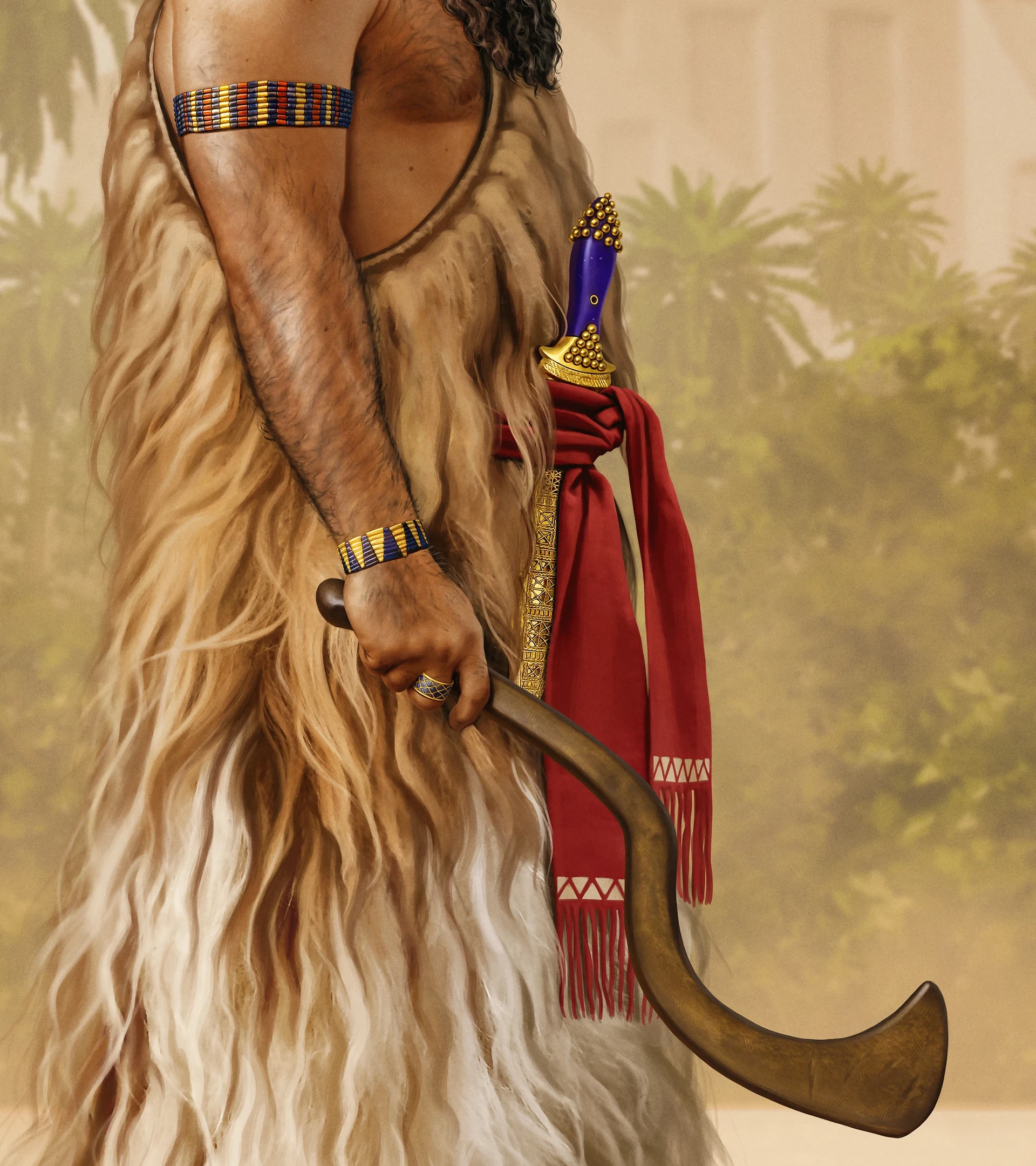
Sumerian king
SUMERIAN KING, Early Bronze Age southern Mesopotamia, modern-day Iraq. Traditionally regarded as the earliest known civilization, Sumer lasted from around 5500 BC to 1800 BC.
Unlike other Mesopotamian powers of the Bronze Age and Antiquity such as the Akkadians, the Babylonians or the Assyrians, which were mostly Semitic-speaking, the language of the Sumerians is considered an isolate as it doesn’t belong to any known language family. Around the early 3rd millennium BC, the Sumerians developed the writing system known as cuneiform, which became the standard writing system of Mesopotamia for millennia. During Classical Antiquity, the cuneiform writing system was also adopted by the Indo-European-speaking Persians, and finally, by the Hellenistic Seleucid dynasty that emerged from the fragmentation of Alexander the Great’s short-lived empire, until it became extinct at the beginning of the Christian Era.
Another notable invention of the Sumerians was the ziggurat, the massive, terraced mud brick temples resembling stepped pyramids that seem to have inspired the Biblical myth of the Tower of Babel, and which also became a cultural symbol of Mesopotamia until Classical Antiquity. Only the base of a small number of ziggurats have survived to our day, as they were basically huge piles of mud covered by a thin layer of baked (and sometimes glazed) bricks.
Sumerian clothing was rather simple, far from the extravagant robes worn by the much later Assyrians. It mostly consisted of wrap-around wool garments to which tufts of long unspun wool were attached.
In this illustration I used the famous golden helmet of Meskalamdug (2550 BC), and the golden dagger of A'annepada (2350 BC), both artifacts from the Royal Cemetery at Ur. The curved wooden club, which is represented in Sumerian iconography as a symbol of power held by kings or gods, is based on a reconstruction by Ørjan Engedal (Bronze Age Warrior Series)