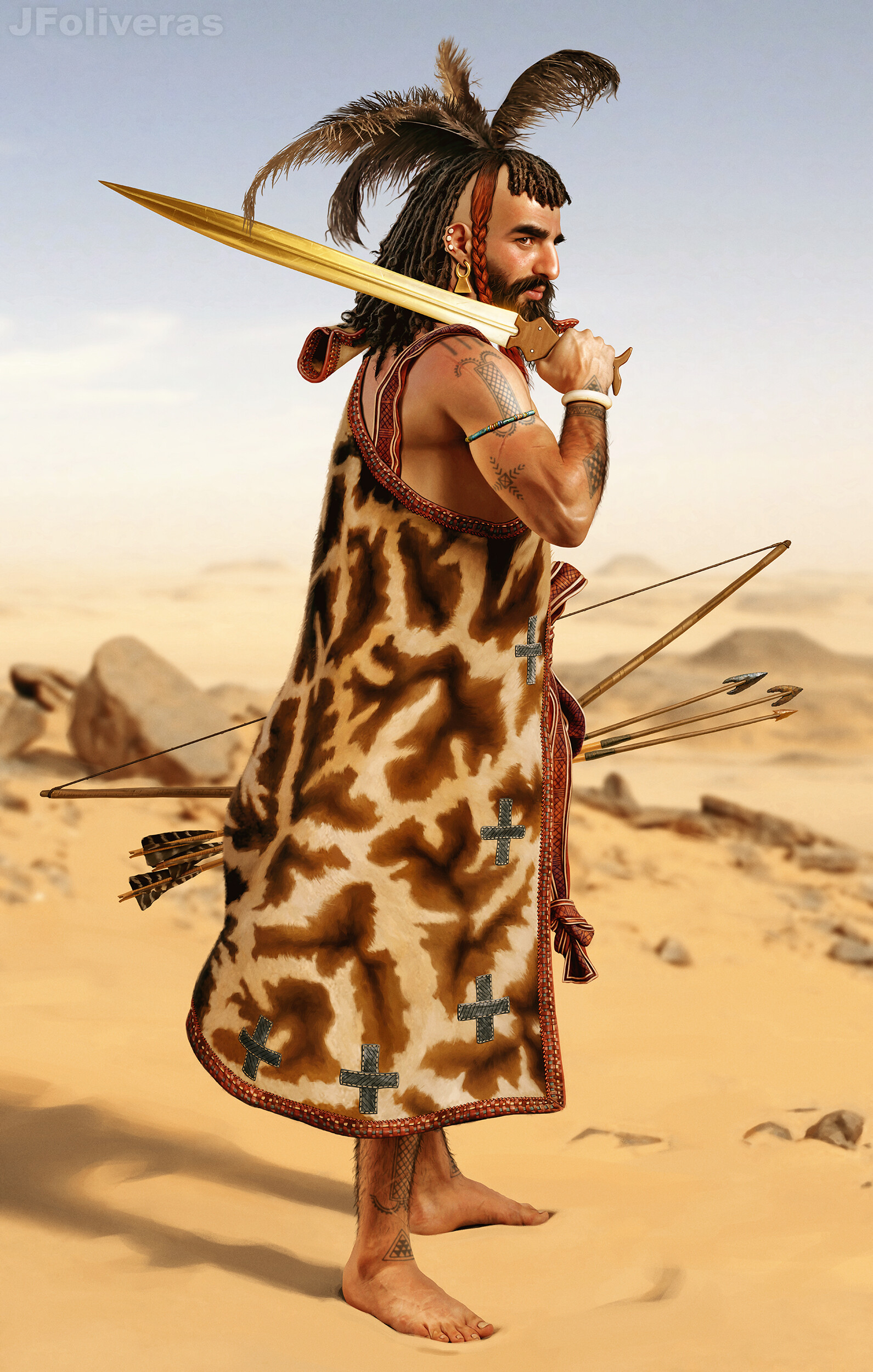
Libyan chieftain
LIBYAN chieftain from the Late Bronze Age. The ancient Libyan tribes, of Berber / Amazigh origin, lived a nomadic and semi-nomadic life between the Mediterranean coast of North Africa and the oases of the Sahara, being the western nemesis of pharaonic Egypt. The Libyan tribes of the Libu (after whom the entire region of Libya was later named by the Greeks), the Meshwesh, the Temehu, the Tehenu and the Rebu, formed a coalition with some groups of the Sea Peoples such as the Sherden, and invaded Egypt on several occasions. Ramesses III (reigned from 1186 to 1155 BC) was one of the pharaohs that led successful military campaigns against the invading Libyans and their Sea People allies.
Ancient Egyptian art stereotypically represented the Libyans practically naked except for a loincloth and a cloak, both garments probably made of dyed and painted leather. Egyptian art often represents the cloaks of the Libyans having irregular patterns, that have been interpreted as either cow or giraffe hide. The Libyan in my illustration wears a cloak made of exotic giraffe hide, imported from south of the Sahara. Other common characteristics of the Libyans in Egyptian art are the ostrich feathers on their head, their elaborate hairstyles, and their tattoos. Sometimes they are also represented wearing some jewellery such as earrings, necklaces and ear studs. The most common weapon of the Libyans during the Bronze Age was the bow, with primitive stone-tipped arrows. Egyptian reliefs also suggest that some Libyans acquired southern European bronze swords from their Sea People allies during the campaigns against Egypt, as indigenous metallurgy in Libya was presumably very scarce. Another interesting feature of how the Libyans were portrayed in Egyptian art is their skin colour. Ancient Egyptian artists stereotypically represented Libyan warriors with light yellowish skin (the same skin colour they normally used for pale Egyptian women and for West Asians), in contrast with the dark reddish brown they used for the tanned Egyptian men, although representations of darker-skinned Libyans are also known, suggesting that tribes living further south were probably darker.