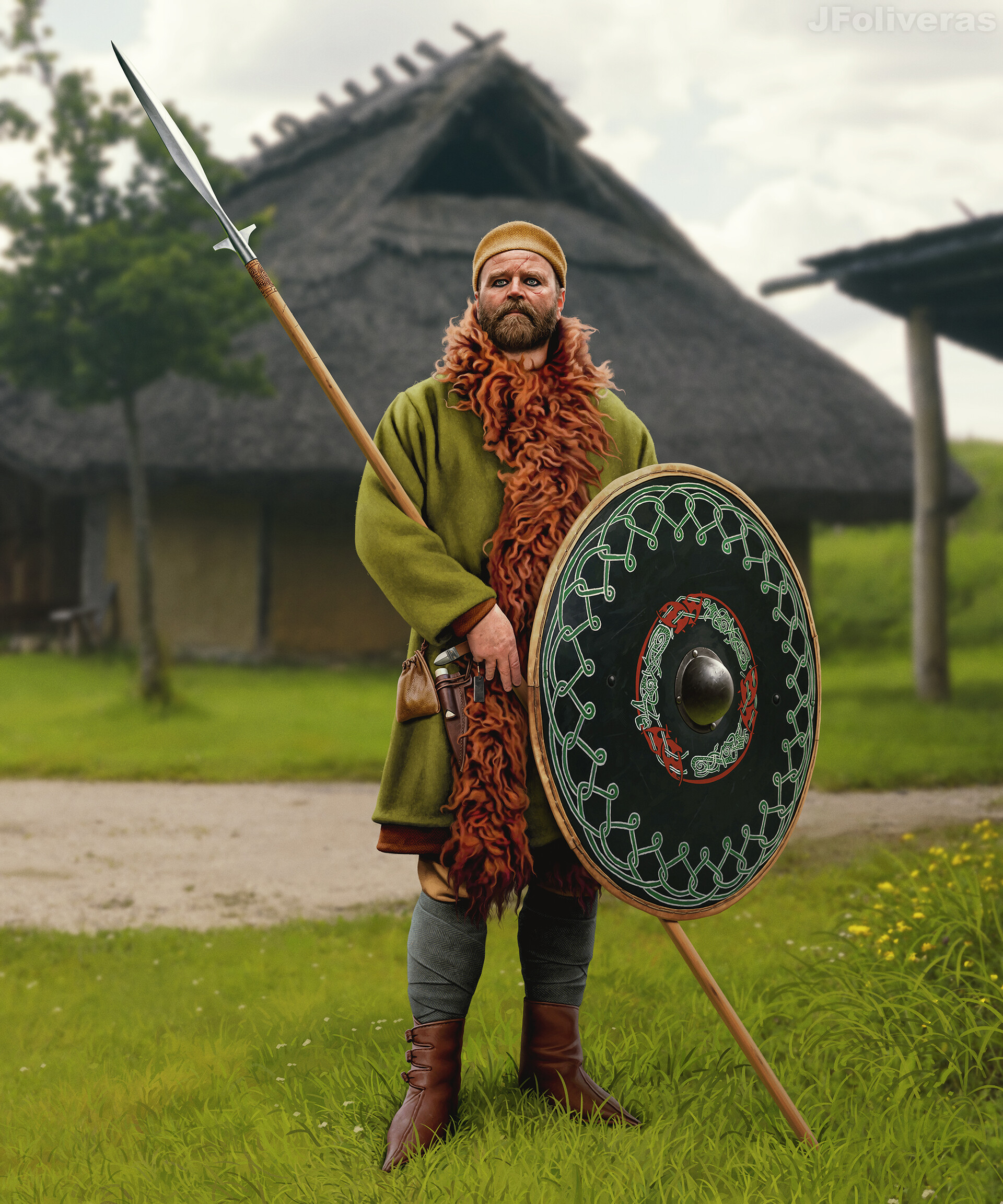
Danish Viking from Hedeby
DANISH VIKING from the trading settlement of HEDEBY (also known as Haithabu in German, as the site is in the German part of the Jutland Peninsula), 10th century. Much of the little we know about Viking age clothing is based on preserved textile finds from Hedeby, such as the famous baggy pants and the leg wraps / winingas often seen in modern reenactment, or the far less represented hoses. Also, from Hedeby comes the find of a “klappenrock” coat, a garment that may have entered Europe from the Eurasian steppe during the Migration Period and became a symbol of the Germanic warrior elite of Vendel Period Sweden, Denmark and Early Anglo-Saxon England. Although these coats went out of fashion among the Anglo-Saxons during the subsequent Viking Age, the Danes and possibly other Norse peoples, continued wearing them. The edge of the coat from Hedeby is trimmed with a kind of fake fur known in modern Icelandic as “varafeldur”, made from sheep wool. This warrior also wears a pillbox hat based on a find from Hedeby, but a similar hat has also been found in Greenland. The toggle boots with a pointy tip are also based on a find from Hedeby. From the belt hangs a knife, a pouch and a touchstone, all these accessories also based on finds from Hedeby. The motifs of the shield are a speculative reconstruction of the Grimstrup fragments (Hørning, Denmark, 950 AD), which may have originally been a shield although this isn’t clear. The winged spear is of a type that was quite common in Viking Age Scandinavia. Such spearheads were likely imported from the Carolingian Empire, as they are commonly represented in Carolingian manuscripts.
Notice that this Dane is wearing eyeliner. A 10th century Jewish traveller from Al-Andalus named Ibrahim ibn Yaqub at-Turtuixí (born in the modern Catalan city of Tortosa, near the Ebro Delta, when it was part of the Caliphate of Córdoba) travelled across western and northern Europe, and visited Hedeby, where he presumably saw some Danish men wearing kohl around their eyes (or another substance resembling it). It must be said that Ibrahim’s original text hasn’t survived. We only have a cite from a later Arab author called Al-Bakri.
Modern replicas used:
- Replica of the klappenrock coat from Hedeby by Mette Wikkelsø.
- Speculative reconstruction of the Grimstrup shield by Szczytnik - Shields with History, with paintwork by Jacob Leo Johnsons (ljo_vikingcolours on Instagram).
- Knife from Hedeby by Jorgen Knochenschnitzer.
- Decorative carving on the spear shaft by Götz Breitenbücher.