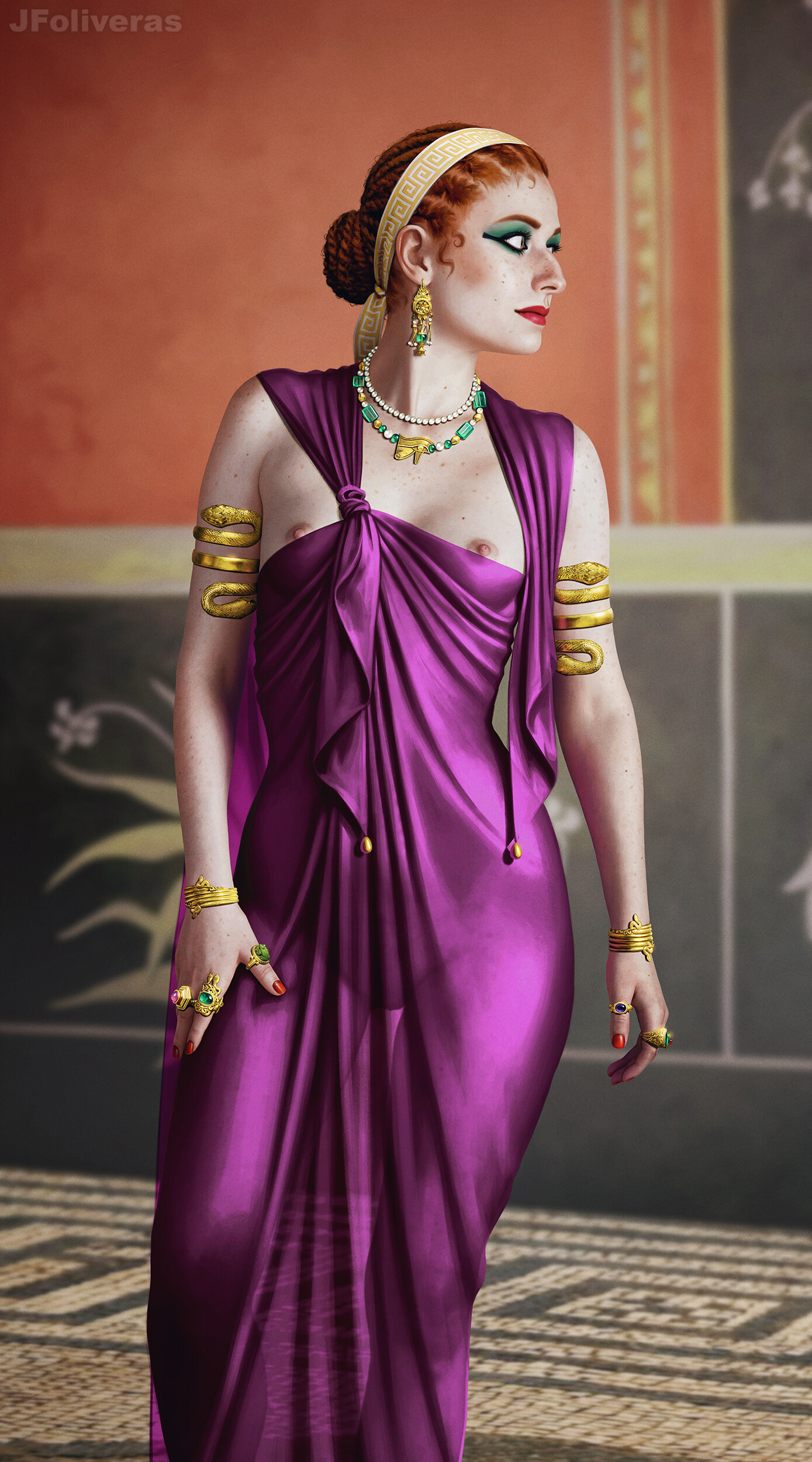
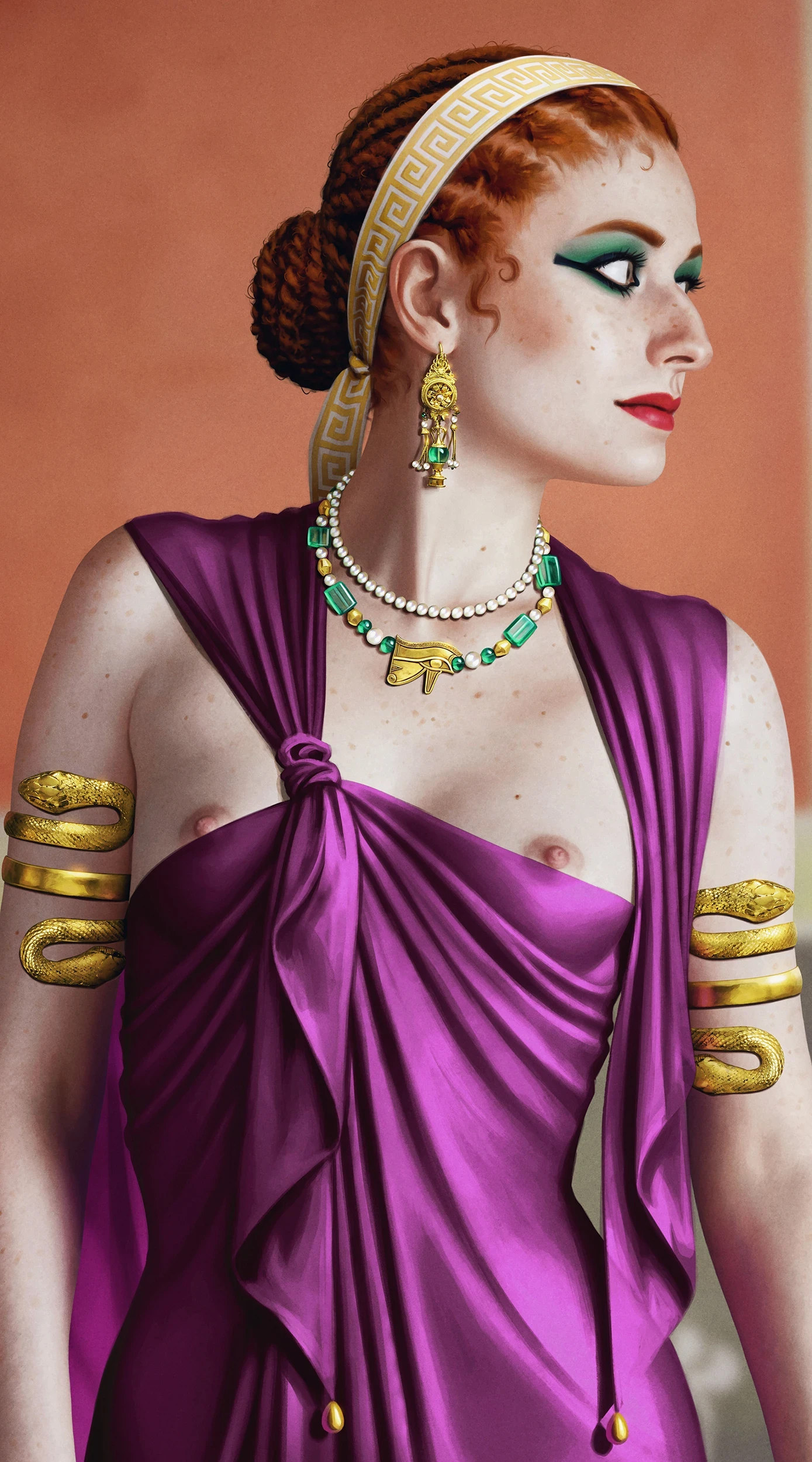
Cleopatra VII of Egypt
CLEOPATRA VII PHILOPATOR (70 BC – 30 BC), the last ruling PHARAOH OF EGYPT.
Cleopatra was a member of the Ptolemaic dynasty, which was entirely Greek. The dynasty was founded by Ptolemy Soter, who was one of the Macedonian generals of Alexander the Great and his successor in Egypt. The Ptolemies, as deified pharaohs, adopted the custom of marrying only members of their own family. Occasionally, the Ptolemies would marry members of other Greek dynasties like the Seleucids, who had some Sogdian ancestry (via Seleucus’ wife Apama, daughter of Spitamenes, the Sogdian enemy of Alexander). So, Cleopatra didn’t have a single drop of native Egyptian blood. The Ptolemies only spoke Greek, and Cleopatra VII was the only one who learned the Egyptian language. Despite being culturally, linguistically and ethnically Greek, they adopted the Egyptian gods in a syncretism with the Greek ones.
This reconstruction of Cleopatra is based on her (idealized) marble busts, which depict her characteristic twisted locks of hair tied in a bun at the back and a royal diadem. Her coins show the same hairstyle and diadem, but with a less idealized face (rather caricaturesque). Her coins are not very consistent but always depict her with an aquiline nose. The pale skin tone and reddish hair are based on a few frescoes from Pompeii and Herculaneum that presumably represent her. The sheer dress, which combines Egyptian and Greek traditions, is based on statues of deified Ptolemaic queens. Later adopted by Roman sculptors in a less revealing way to represent the goddess Isis, in Ptolemaic statues this dress always leaves the breasts exposed as was common among native Egyptian women. A 1st century Roman author, Lucan, also describes Cleopatra wearing a see-through dress of Chinese silk that reveals her breasts, a fortune in pearls from the Indian Ocean, and heavy make-up. I gave her emeralds because Greco-Roman Egypt was the source of all the emeralds of the Old World.
Cleopatra played an important role in the transition from the Roman Republic to the Roman Empire. Her involvement in Roman politics started with her affair with the dictator Julius Caesar, at the end of the Roman Civil War, from which a son named Caesarion was born. After Caesar’s assassination, she allied herself with Octavius (the future emperor Augustus), Marcus Antonius and Lepidus in the war against Brutus and Cassius, the instigators of Caesar’s death. Later, she had an affair with Marcus Antonius, who was married to Octavian’s sister. Cleopatra and Marcus Antonius had four children, one of which, Cleopatra II Selene, would marry the Berber king Juba II of Numidia and Mauretania. Julius Caesar had appointed Octavian as his successor, but Marcus Antonius and Cleopatra proclaimed Caesarion as Caesar’s successor and king of Egypt (although real power would remain in Cleopatra’s hands). This led to Octavian declaring war on Cleopatra and the traitor Marcus Antonius. With Cleopatra’s final defeat, 3000 years of pharaonic rule came to an end, Egypt became a Roman province, and Octavian was proclaimed the first emperor, taking the name of Augustus. The Roman Empire was born.
REMINDER: Cleopatra lived chronologically closer to the first Moon landing than the construction of the pyramids. In fact, when the pyramids were built, mammoths still roamed parts of Siberia.