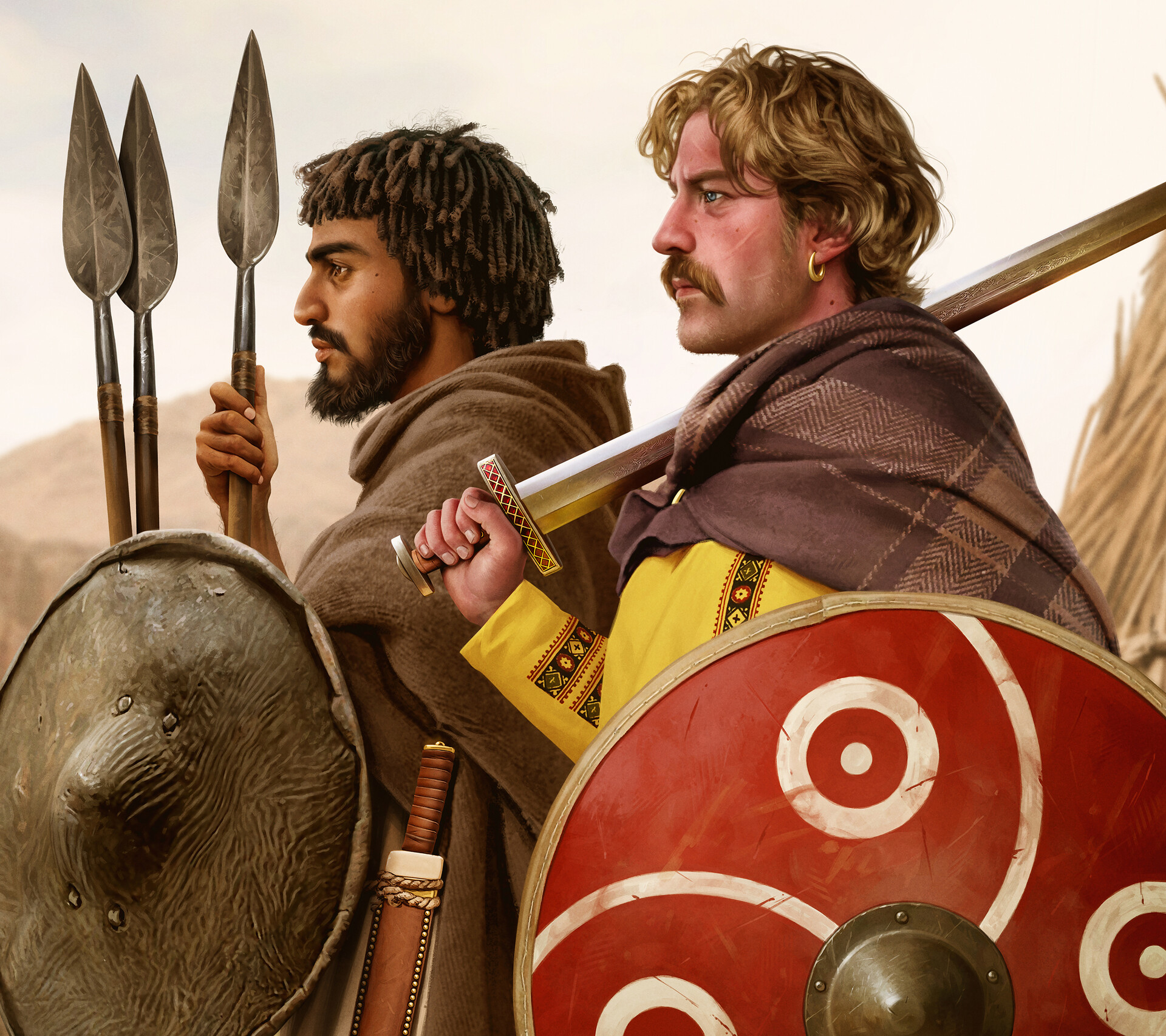
Vandal nobleman and Mauri mercenary
VANDAL nobleman and MAURI mercenary in North Africa, somewhere south of the Atlas (5th century AD). The general appearance of the Vandal is based on 5th or 6th century mosaics from Carthage (Tunisia). He wears a Late Roman “Coptic” tunic, and a barbarian tartan-like cloak. He carries a sword decorated with garnet cloisonné, which is based on a find from a warrior’s grave from Beja (Portugal). This sword has Asiatic influence, as a result of the Vandal’s coexistence with the nomadic Alans in Hispania. Similar swords were also used by the Huns. The clothing of the Mauri (an ancient Amazigh people of modern-day northern Morocco and Algeria, also known today as the Moors) is based on a 4th-6th century stele from Djorf Torba (Algeria), and the 5th-6th century Eastern Roman poet Flavius Cresconius Corippus, who describes the Moors dressed in an unbelted sleeveless tunic and a thick mantle, barefoot and armed with 3 very heavy spears, a hide shield, and a short sword suspended from the shoulder with a cord. The Moorish short sword is inspired by a find from a 2nd century Numidian tomb at Soumaa d’el Khroub (Algeria). The hairstyle is based on Roman representations of Mauretanians and Numidians. The huts are based on a Roman mosaic from El Alia (Tunisia).
THE VANDALS were a Germanic tribe of Scandinavian origin that migrated from the Baltic region to Central Europe and then Roman Gaul, finally conquering part of the Iberian Peninsula alongside the Iranic-speaking Alans (who had migrated from the Caucasus). The Vandals and the Alans ruled Hispania until they were pushed to Africa by another Germanic tribe: the Visigoths. The Vandals and the Alans managed to conquer Roman Africa, and from there, they launched a fleet of ships to Italy and sacked Rome in 455 AD. The “Eternal City” had already been sacked by the Visigoths in 410 AD. The Western Roman Empire finally collapsed in 476 AD. The Vandal kingdom would last until 534 AD, when it was destroyed by the Eastern Roman general Belisarius as part of emperor Justinian’s restoration of the Roman West. The Eastern Romans, or Byzantines, retained control of the Maghreb until the Islamic conquest of the 7th century.